
Ākonga driving change through active, sustainable journeys
Ākonga driving change through active, sustainable journeys

At St Mary’s School in Carterton, tamariki are learning about climate change and turning that learning into action.
By collecting and analysing data on how they travel to and from school, ākonga at St Mary’s School are exploring the climate impact of everyday transport choices and what they could do differently.
The results have been tangible. The school has reduced its weekly transport emissions by 138 kilograms of carbon dioxide equivalent – the same as a car travelling 570 kilometres.
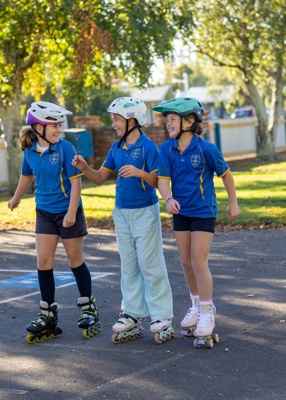
St Mary’s is one of 22 schools across the country that took part in On Our Way in 2025. The cross-curriculum programme from the Ministry of Education, supported by Sport NZ through Healthy Active Learning, encourages ākonga to travel to and from school in active and sustainable ways.
A real-world challenge
Every day, an estimated 835,000 ākonga and staff commute to school, with most trips made in private vehicles. This represents more than 30 percent of the education sector’s total emissions – it’s the single biggest contributor.
On Our Way helps schools to take on this challenge by giving them an all-of-school opportunity to build ākonga climate literacy, by exploring how the climate influences them, and how their actions influence the climate.
By collecting transport data and using it across curriculum areas, students learn to understand, analyse and turn insights into action.
Aligning with values
St Mary’s saw an immediate fit between the programme and the school’s values of caring for self, community and environment.
“Our climate is changing and our ākonga want to understand their role and control over that change.”
“On Our Way provides a pathway to prepare them for a low-carbon future,” says kaiako Liz.
With support from their Regional Sports Trust, Nuku Ora, the school’s programme sits alongside wider sustainability initiatives.
These include Enviroschools’ programmes like the māra kai (food garden) and Movin’ March, an annual initiative that encourages Wellington primary school students to walk, cycle, scooter or ‘wheel’ to school.
Kaiako have also integrated climate and energy concepts into science learning through the House of Science resources, while hands-on activities like tree planting highlight kaitiakitanga and community connections.

Positive impacts for students and whānau
The programme begins with ākonga building a picture of their school’s carbon footprint through collection and analysis.
Supported by teaching resources, they explore their transport environment, assess the climate impact of different choices, and consider alternative options that will work best for their community, now and into the future.
Liz says the use of real-life data helped identify an increase in car travel on Fridays, which has become a future focus for inquiry.
The programme has also reached beyond transport choices. Ākonga are more confident and engaged in hands-on learning inside and outside the classroom.
Whānau are also part of the journey, with more informed discussions about active travel taking place.
“We’ve seen robust discussions and a shift in thinking. Tamariki are asking how we can do things differently.”
How to access resources
The scope of On Our Way has been refined. While data collection and tailored emissions reports are no longer part of the programme, schools and kura can request a copy of their annual carbon footprint reports.
On Our Way learning resources can continue to be accessed via the app. Resources remain available to support teaching and learning.
Kaiako with a school email address (e.g. @school.nz) can access On Our Way resources by visiting the app, entering their email address and following the prompts. The app brings together all key information and resources. Questions should be directed to emissions.reduction@education.govt.nz.
Visit the On Our Way app.
 Practical tips for schools
Liz shares the following tips for schools wanting to champion climate literacy and active travel.
- Find a passionate champion to lead the mahi.
- Ensure you have the support of your board and principal.
- Allocate time and support – Resource teacher, teacher aide or learning assistant roles can work well for garden and small group sessions.
- Use the local environment as a classroom for science and wellbeing.
- Integrate movement and sustainability into existing subjects to enhance learning.
- Collect real data – transport surveys are a powerful way to engage tamariki in climate science.
This article was originally published in the Education Gazette, 25 May 2026.


